

2025 Equipment Call
MECANO – Quantum Nonlocality with Mechanical Oscillators
Project Leader: Adrien Borne, Associate Professor, MPQ
Funding: €40,000 for the purchase of two superconducting nanowire single-photon detector channels.
The motion of a massive mechanical resonator at the mesoscopic scale can exhibit quantum behavior when cooled to ultra-low temperatures. The micrometric disks fabricated by our team (see photo) also confine optical modes that interact strongly with the motion. Light therefore makes it possible to engineer the quantum state of the motion of such an object when it is prepared near its ground state (the “phononic vacuum”), by adding or removing phonons one by one. In the MECANO project, these interactions—conditioned on the detection of single photons—are used to generate quantum entanglement between the mechanical modes of two such resonators arranged in an interferometric configuration. A delayed-choice quantum eraser experiment will make it possible to probe nonlocality at a mesoscopic mass scale.
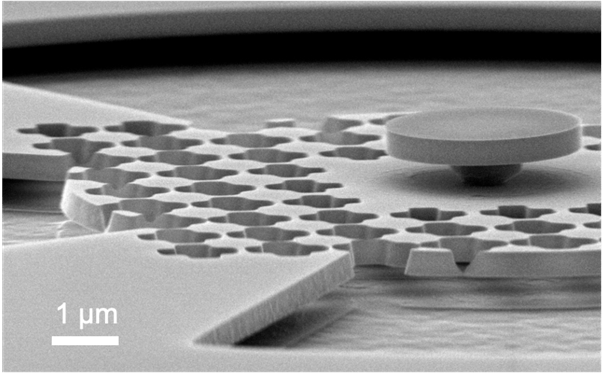
Scanning electron microscope image of an optomechanical disk on a structured membrane reducing mechanical losses.
Projet WHIRMA – White Rabbit Meets Alice
Project Leader: Valentin Cambier, Associate Professor, MPQ
Funding: €34,500 for the purchase of a White Rabbit switch, an optical amplifier, a multifunction polarization controller, and frequency-locking electronics.
The WHRIMA project aims to develop quantum communication and computing technologies based on entangled photons and trapped ions. It relies on AlGaAs-based photon sources, which offer strong nonlinearity and compatibility with telecommunications networks for multi-channel entanglement distribution. In particular, the project seeks to develop a photon-ion interface, which is essential for quantum networks. However, although surface traps already enable the generation of ion-photon entanglement, technological challenges remain for deployment at the telecommunications scale. To address this challenge, WHRIMA will leverage the REFIMEVE and White Rabbit infrastructures to improve the distribution, stability, and synchronization of signals. Ultimately, this project will enable the development of a high-performance quantum network, thereby contributing to the international visibility of Paris in quantum technologies.
Projet VarQ – White Rabbit Meets Alice
Project Leader: Cristiano Ciuti, Professor, MPQ
Funding: €40,584 for the purchase of 2 GPUs.
The VarQ project is part of a broader research program leveraging quantum and photonic dynamics for applications in machine learning, analog computing, and optimization. It aims to develop and apply a novel variational multi-Gaussian (VMG) algorithm to simulate the dynamics of strongly correlated, open, multimode bosonic systems, using a phase-space representation based on the Wigner function. The VMG method, optimized for GPU architectures, represents a major breakthrough, enabling the accurate and numerically efficient simulation of many-mode quantum systems. The acquisition of high-performance GPUs, essential to fully exploit this approach, will enable large-scale simulations, the exploration of broad parameter spaces, and the acceleration of algorithm development.

2025 Intervention Call
Chromium Quantum Gases
Project Leader: Laurent Vernac, Associate Professor, LPL – USPN
Funding: €6,646.88 for the replacement of an air conditioning unit.
Magnetic atoms such as chromium interact with each other at a distance via dipole–dipole interactions, enabling the study of out-of-equilibrium quantum magnetism. In the LPL experiment, the atoms are trapped in optical lattices created by lasers. To ensure the stability of the experimental setup, the temper at ure of the experimental room must be kept constant.
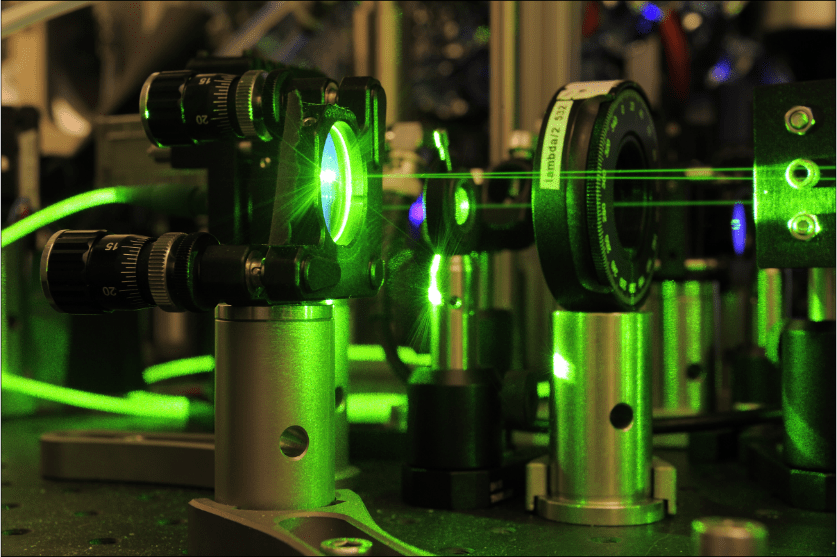
Experimental setup showing light creating optical lattices.
Quantum-FRESCO: Quantum Noise reduction via FREquency dependent Squeezing for next generation on gravitational-wave deteCtOrs
Project Leader: Eleonora Capocasa, Associate Professor, APC
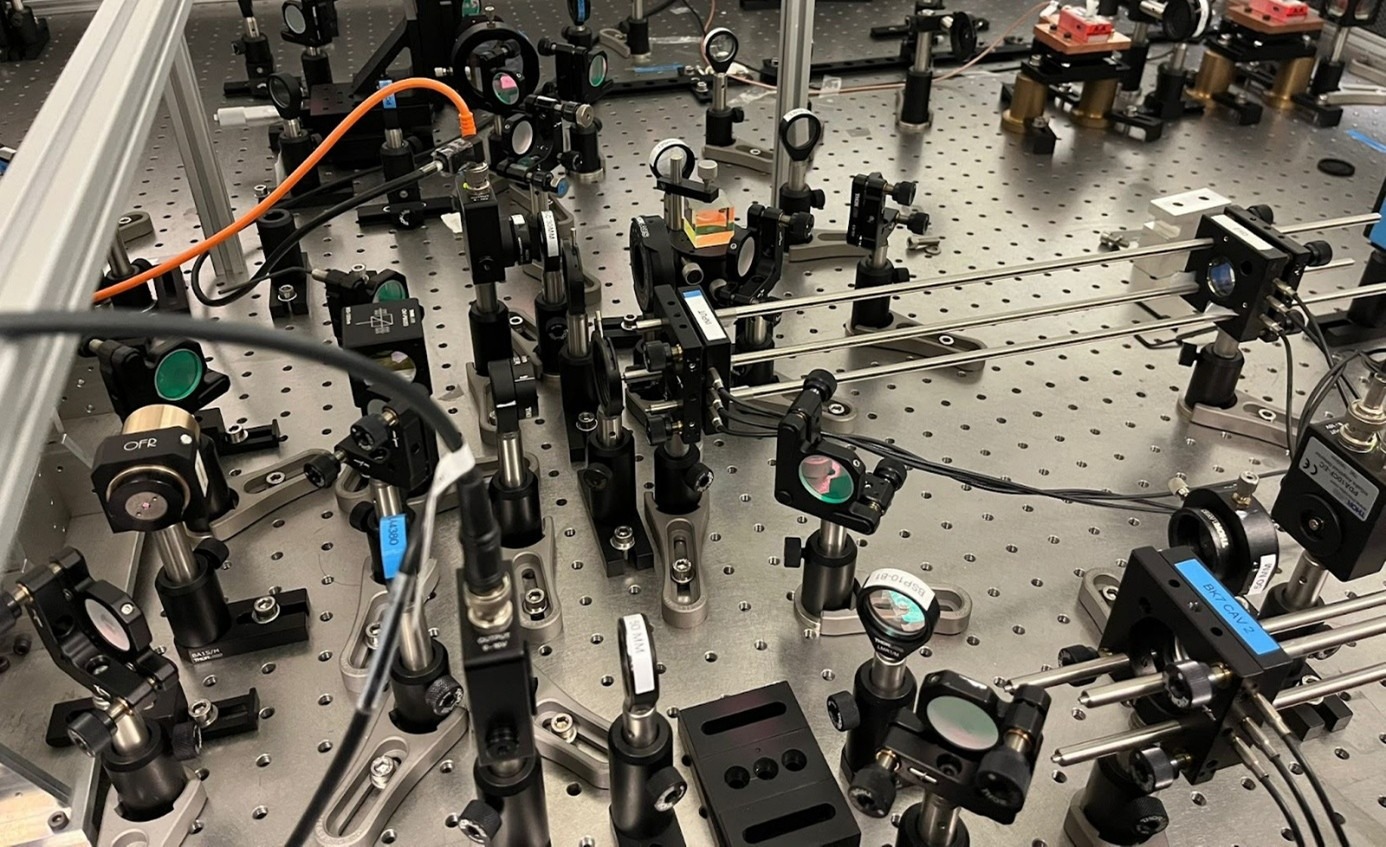
Funding: €8,336 for the repair of a laser.
The Quantum-FRESCO project aims to develop a squeezed vacuum source to reduce quantum noise in next-generation gravitational-wave detectors, such as the Einstein Telescope. It relies on advanced frequency-dependent squeezing techniques, which are essential for improving sensitivity across the entire detection bandwidth.
Sodium Project
Project Leader: Aurélien Perrin, Research Scientist, LPL–USPN
Funding: €5,000 for the replacement of an acousto-optic modulator.
The sodium project aims to produce quasi-one-dimensional Bose gases of ultracold atoms in order to explore out-of-equilibrium quantum physics. Using advanced cooling and trapping techniques, including atom chips and tailored optical potentials, homogeneous systems can be achieved.
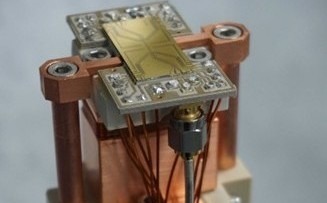
Device used to generate the magnetic potentials in which the atoms are confined.
MIR-QCL : High-resolution mid-infrared spectroscopy of cold chiral molecules with a 6 µm quantum cascade laser
Project Leader: Mathieu Manceau, Associate Professor, LPL–USPN
Funding: €5,000 for the replacement of a laser chip.
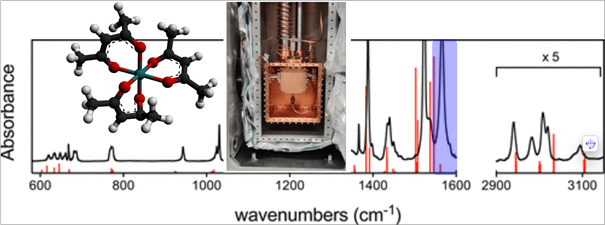
The MIR-QCL project aims to exploit cold molecules to perform high-precision quantum measurements, in particular parity violation. It relies on high-resolution MIR spectroscopy of Ru(acac)₃ using a quantum cascade laser and a cryogenic gas. This work will pave the way for the detection of extremely small effects and the exploration of subtle phenomena beyond the Standard Model.
Read more

The Graduate School Quantum Technologies joins the European Quantum Academy!
The Graduate School Quantum Technologies at Université Paris Cité is proud to announce its participation in the new European initiative Quantum Academy, launched to train the next generation of talent in quantum technologies across Europe. © European Quantum Academy...

Quantum Plan of Université Paris Cité: a structured approach to research, education, and innovation
Quantum technologies are now a major scientific field in which Université Paris Cité is actively engaged, conducting research and education initiatives in a structured and complementary way through its Quantum Plan. This plan aims to foster new ideas, strengthen synergies, and build innovative partnerships with socio-economic stakeholders. Lire la suite Quantum Plan of Université Paris Cité: a structured approach to research, education, and innovation

Biphoton state generation and engineering with bright hybrid III–V/silicon photonic devices
The QITE team at the MPQ Laboratory, in collaboration with STMicroelectronics, C2N, and INPHYNI, published a paper in Optica Quantum on the generation and engineering of two-photon states using III-V/SOI hybrid devices. Lire la suite Biphoton state generation and engineering with bright hybrid III–V/silicon photonic devices

Quantum Computing and Quantum Physics Explained Differently
Quantum computing and quantum physics are now major scientific disciplines, but they remain complex to understand. To make them more accessible to non-expert audiences, Sophie Laplante, Associate Professor in algorithms and quantum and classical computational complexity at IRIF, the Fundamental Computer Science Research Institute (Université Paris Cité/CNRS), and appointed Senior Member of the Institut Universitaire de France (IUF) in 2025 under the Science Communication Chair, designs educational tools. Lire la suite Quantum Computing and Quantum Physics Explained Differently